Remembering Stockholm
(a) Usain Bolt’s winning race was intense. With the gun's firing, he ran, and so did his mind. During those nine seconds, Bolt’s mind was full of thoughts. He thinks about whos in front of him, whos behind him, or anyone who may be trying to pass him. He spots his most lethal opponent, Richard Thompson. According to Bolt, Thompson “...got a start like nobody else in the history of the Olympics.” This concerned Bolt, so he began extending his ‘legs out of the drive phase’ and sprinting.
He stumbled and made a lousy step but quickly regained his balance. ‘Remember Stockholm’ was what he told himself. To be chill and do not panic. Bolt ended up building his momentum and passing Thompson. He was now in the lead.
He peered over his shoulder for his ‘breeder’ and teammate, Asafa, but he was nowhere to be seen. That seemed ‘stupid’ to Asafa because ‘he was supposed to be there.’ As he reached the 80 metres mark, his worries grew until it dawned on him. “Oh man, oh man … I’m gonna win this race”, was his last thought before passing the finish line and taking home the gold.
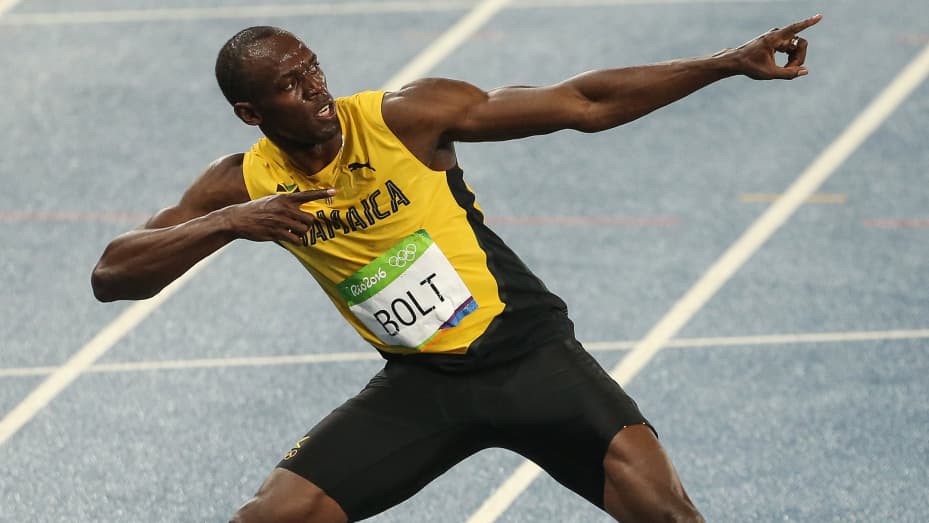
(b) Usain Bolt’s autobiography extract had a solid structure, language, and form. Its structure was in chronological order, which helps you keep track of what's happening. He discussed everything that went on. He starts off with an onomatopoeic; Bang!. The use of this word connects to the sound of the gun and draws its audience in. Then he used; Pow!. This word described his ‘burst from the blocks’ and the beginning of the race.
Throughout this extract, Bolt goes from describing the scene around him to the thoughts he has in his head. He often thinks about ‘Stockholm’. “Remember Stockholm.”-- he tells himself. “Do not panic. Get through your drive phase and chill.” Bolt is constantly reassuring himself and trying his best to remain cool with his internal dialogue.
The extract has a change in tone when Bolt spots his most lethal opponent, Thompson. Thompson was, “...the only dude leading the pack.” Bolt acted fast and built his momentum and went for it. Before he knew it, he was in front of him. The following tone change was when Bolt could not spot his ‘breeder’ - a Jamaican dialect word meaning brother - and teammate, Asafa, during the race. This concerned him tremendously because Asafa was supposed to be there. ‘This is kinda weird’ — Bolt thought to himself as he glanced over his shoulder for him. When the realization kicked in. Bolt's mood completely changed and his stress lifted. Shortly he was throwing his hands up in the air and pounding his chest in pure joy. “It was done. I was the Olympic champion.” Yet again his mood changed, but this time for the better.
My newspaper report included a solid structure, language, and form. My structure was written in chronological order just like the autobiography. I narrated every move that was being made. Not only that, but our language was similar. They both included colloquial words and phrases like ‘chill’, along with the dialect word, ‘bredder’. The use of imperative verbs within the internal dialogue was shown through Bolt's persistence in remembering Stockholm. He continued to remind himself to ‘chill’ and ‘do not panic.’ My form, or intention, was to provide information on the 100 metre race and the winning of Usain Bolt. I discussed the key events and the occurrences that went on.
Both texts share multiple comparisons. Considering my journalist report was solely based on Bolt’s extract, it was difficult not to.
To Madison,
ReplyDeleteQuestion 1(a)
AO1) For this section of the question I give you 4 marks. The reason why I give you 4 is due to the way you started, ended but also throughout the newspaper article that you wrote. I believe that you did a really good job of giving a detail and understanding of the text and keeping it short and not making it complicated for the reader to understand for Instance when you said “With the gun's firing, he ran, and so did his mind. ” this is a great Example of when you “dumb down” the autobiography in your newpaper article for when you were writing. The reason why you didn't get 5 marks is because I didn't like the quotes that you used when you were talking about Usain Bolt. There was one really good quote that you did use that he said, but that was one out of three. I think the context and meaning of your newspaper article hit all of the points in level four. I think you address your audience very well when writing the newspaper article. In order to get five marks you need to have according to the rubric “insightful reference to characteristic features” and that is one thing that I believe that you are lacking in the newspaper article. However you did have “Effective references to characteristic features'' in your newspaper article. Those are the reasons why you got 4 marks and not 5.
AO2) For the section I give you 4 marks. I believe you hit all of the key points in this section very well. When reading your newspaper article you have effective expressions and few minor errors in your newspaper article which is stated in the rubric which does not affect the communication between the writer and the reader. You made it very clear that the audience was fans of Usain Bolt but also You developed your Ideas in an effective way so that people could understand it, without over-explaining it, for Instance when you said “To be chill and do not panic. Bolt ended up building his momentum and passing Thompson. He was now in the lead. ” This is a good example of you using 3 Short sentences to explain how Usain Bolt messed up but then recovered and ended up taking the lead, but you did it in a Professional manner as well.
To Madison,
ReplyDeleteQuestion 1(b)
AO1) For this section on part B I gave you 4 marks as well, due to the fact that you give a complete detailed description and understanding of yours and the autobiography text. When giving a detailed description about the newspaper text that you have written, one of the good examples that you used for sentences that you wrote about structure and language in your newspaper was “Not only that, but our language was similar. They both included colloquial words and phrases like ‘chill’, along with the dialect word, ‘bredder’. ” Reason why I think this is a great example of how you were riding in part B is due to the fact that you were mainly talking about your use of structure and language but you also brought in the autobiography as well. I think you had some good examples about the effective references to characteristic features, the problem was with some of the quotes that she used I think you could've had some quotes that enhanced Usain bolt's features a little bit more and I know that you tried to use one word quotes but you didn't quite hit the inside for references in level five and that is the reason why you didn't get five works. Such as “pow!”and “bang!” I think you could've used a longer and more impactful quote to explain how he was feeling in that Moment. That is the reason why you got 4 marks.
AO3) You give an ‘comparative analysis of the elements and form’ but not a ‘Detailed comparative analysis of form, structure and language’, this was the main reason why I'm giving you 6 marks instead of seven or eight because you could've gone into more detail. “‘This is kinda weird’ — Bolt thought to himself as he glanced over his shoulder for him.” This is a good example of you getting a clear comparative analysis of an element such as language but you're not going into detail on why you use this in part B meaning that you could have expended on this more than you did. I believe that you did a great job on ‘stylistic choices related to the audience’ that's why I gave you a 6 marks and not 5.
Hey Madi, your blog was very good and had great structure when describing the end of the race to the beginning. However, the language and tone hould be for a newspaper article. Therefore, don’t include any quotes and exact thoughts Usain would be having, since you’re just simply explaining the event as if you watched it first hand. Still, when including the “He was now in the lead,” and “he stumbled,” you did it correctly since it feels like you are describing everything you saw. For AO1 I would give you a Level 4 since I can tell you understand the prompt. In AO2 I would give a level 2 only because of the audience.
ReplyDeleteOn question B you correctly identify the structure, language, and form and give many examples to support your reasoning. You identify how the autobiography uses onomatopoeic for the structure and show it by words like “Bang! Pow!” You also identify a change in tone. When comparing your report you identify the use of imperative verbs. For the AO1 and AO3 on question B, I would give you a level 4 for both.