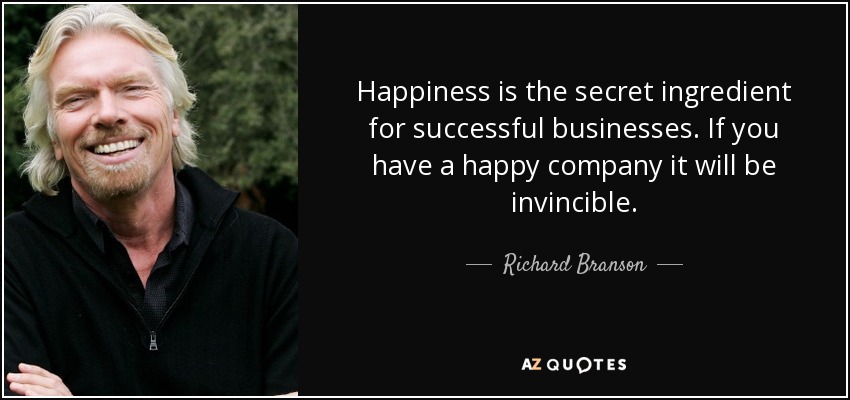
The writer of the letter, Richard Branson, wrote a letter directed toward strangers about happiness. He uses real-life experiences as well as ones of his own when making his point. Even though he is a famous entrepreneur and may seem like he has everything including happiness – that isn't always the case. Branson uses lexical features like irony when discussing how wealth and fame do not always equal satisfaction. Happiness is a choice. One must choose to be happy. Nothing in this world will provide you with this emotion other than yourself.
Branson's message displays a concrete form, structure, and language. The form of this letter was written as a letter. He began by addressing his audience which was ‘strangers’ and conveying a powerful message to them. In paragraph nine he formally addressed the readers as human beings. Humans have the ability to ‘think, move and communicate’ as well as display corporation, understanding, reconciliation, and love. The use of the ‘you’ throughout this text shows his clear acknowledgment of his audience. By doing this Brandon keeps his readers engaged and interested in what he has to say.
In addition, he used short paragraphs which simplified his ideas and directive. He finished his letter off by saying ‘happy regards’ and then proceeding to sign his name. He took all appropriate measures and wrote nicely in the form of a letter.
The structure of this text covered opinions, advice, and other factual information. In paragraph one Branson introduces the main topic – happiness. In line five he says, “It can be yours if you take the time to let it grow.” Branson’s main view was portraying the idea that happiness must come from within. From the beginning, we can see the layout of this letter. Branson’s goal is to inspire strangers with examples of how to be utterly happy. In the first three paragraphs, Branson focuses on his own life experiences and how they correlate to the topic. He acknowledges his fortune to live the ‘extraordinary’ life he has along with his business and wealth successes. From all of that he makes one point, “I am successful, wealthy, and connected because I am happy.”
Branson goes on to include other real-life examples that all audiences would relate to – the world’s expectations. He shows this in the form of a question, ‘What do you want to be when you grow up?’ A question that almost every person has encountered. There is a constant pressure on human beings to be ‘successful.’ This is all thanks to the world’s anticipations of ‘grandiose aspirations.’
Branson ends with the statement, “Take the focus off everything … I promise you, happiness will follow.” This entire letter’s main message was to inform people about the expectations of happiness and how to achieve that mindset on your own.
Many language elements were revealed in the choice of diction in this letter. For example, numerous anaphoras were included. An anaphora is when a word or phrase at the beginning of a line is repeated. In paragraph six we see this with the word, ‘be.’ This paragraph contains information about staying relaxed. Branson says to be healthy, spend time with friends and family, and be bold. He gives readers useful information during these two lines. The word ‘be’ acts as a statement for what those struggling with happiness must have in order to achieve it.
Another example of these language elements is shown in paragraph eight with the leading word ‘it’s.’ Branson uses this lexis when supplying examples of how to be present according to his personal life. He says that holding his grandchild’s hand, looking up at the stars, family dinners, similes on strangers' faces, the first snowfall, and last winter storm, and the sunrise and sunset. By using this phrase – it is – he is amplifying the meaning each event holds for him. By seeing how Branson takes some of the smallest things into consideration, the audience can figure out things that help them become present easily.
Not only were anaphoras used but so were compelling adjectives. The use of these descriptive words helped add depth to the letter. Some examples of this were biggest, used when discussing fears, extraordinary, used when talking about life, and successful/wealthy, used when consulting achievements. Branson uses these words to add to the importance.
Repetition was also a highlight in this letter. Branson continued to mention happiness throughout the text. Almost every paragraph contains this emotion and additional advice on how to achieve it. By repeating this word, Branson is shedding light on the main topic.
Richard Branson’s letter about happiness and how to achieve it contained a solid form, structure, and language and included multiple lexical features. He used the form of a letter when conveying his ideas and made to address the readers at hand throughout. His letter contains multiple paragraphs to easily separate his ideas and messages. Along with this Branson formed language features such as anaphoras, adjectives, and repetition.
AO1: Your understanding of the letter was clean and concise. I saw no issues and really enjoyed reading your analysis of the letter 5/5.
ReplyDeleteAO3: For your actual analysis I only had a couple of problems. One was that you did not expand enough on your quotes. The other problem was you did not analyze tone, which was one of the biggest parts of the letter in my opinion because it strongly affects the structure of his letter since he had to build up a friendly and trusting tone to get the reader to trust his advice. 12/20.
Hey Madi!
ReplyDeleteI really liked how you structured your blog response! In terms of the AO1 rubric, you demonstrated a detailed understanding of the text, as you highlighted the meaning, context, and audience throughout. You began by discussing the focal point of the letter, happiness, and how it impacts people. In doing so, you showed an effective reference to characteristic features that were seen throughout Branson's letter. You went into further detail about features such as Branson's use of irony to further strengthen your analysis. I would award you 4 marks here.
Under the AO3 column, I can see that you had a clear, coherent and well structured analysis. I say that this is a level 3 because I feel that there are some other features that could have been discussed. As previously mentioned, you did a great job at structuring your ideas in your blog. Your structure allowed readers to easily follow along your ideas. Furthermore, you had an appropriate selection of elements of form, structure and language for analysis. I say this because you discussed several characteristic features of these three selections, as you discussed certain points such as anaphoras that were used, adjectives, and repetition used throughout. This shows that you had a detailed awareness of writer's stylistic choices, and how the style relates to the audience and shapes meaning. This is where I bump you up to a level 4. You discussed how the letter repeatedly relates to the audience. Following this, you used effective and appropriate language to link evidence with explanatory comments. I would award you 13 marks here.
Total: 17/25
AO1: ⅗ marks
ReplyDeleteYou show a clear understanding of the text as you describe the purpose of the letter in the first paragraph and throughout your writing show an explanation for form, structure, and language. There are times when you talk about the context of happiness a little too much. For instance, in the fourth paragraph, you sort of continuing to talk about the purpose of the letter instead of how the structure of the text conveyed his ideas. Instead of discussing the purpose more, you could have explained how Branson used short sentences such as, ‘Be present.’ Then explain how the impact of the two words affects and engages the reader as well as convey the advice given. In the language portion of your analysis you only really talk about anaphoric which is repetition. To be more effective in this category you could talk about the usage of lists and how that affects the language being used in the writing.
AO3: 11/25 marks
Your analysis is very well structured and easy to understand as it flows well together. When you analyze the form, structure, and language in the letter you talk about a few things. That being said in the form section of your analysis you could have stated the start beginning with ‘Dear’, how the paragraphs show in the introduction, and then the main ideas, as well as the sign-off at the end. In your structure section as I said early, you could talk about the short sentences used towards the end of some of the paragraphs. In the language section, you talk about repetition most of the time which was a great analysis however, you could’ve expanded more on the rhetorical questions and ‘compelling adjectives’. You are very clear in your explanations of how everything connects to the audience. I feel this is the strongest feature of your analysis. You use appropriate language throughout your analysis but, I felt like I was reading more of a blog than actual analysis, especially in the last few sentences of your first paragraph. While you continue writing the language seems more effective and clear in my opinion.
14/25
ReplyDeleteHi Madison!
AO1: Detailed understanding of text (meaning,audience, context): “The writer of the letter, Richard Branson, wrote a letter directed toward strangers about happiness. He uses real-life experiences as well as ones of his own when making his point. Even though he is a famous entrepreneur and may seem like he has everything including happiness – that isn't always the case.”
Effective reference to characteristic features: “form of this letter was written as a letter.”; “short paragraphs”; “structure”; “choice of diction”; “numerous anaphoras”; ‘lexis’; “Another example of these language elements is shown in paragraph eight with the leading word ‘it’s.’”; ‘Repetition’; “compelling adjectives”
[4 marks]
AO3: Limited Analysis, with some structure and limited coherence: “Branson uses lexical features like irony” You could have discussed irony in its own paragraph.; “ Branson's message displays a concrete form, structure, and language. The form of this letter was written as a letter. He began by addressing his audience which was ‘strangers’ and conveying a powerful message to them. In paragraph nine he formally addressed the readers as human beings. Humans have the ability to ‘think, move and communicate’ as well as display corporation, understanding, reconciliation, and love. The use of the ‘you’ throughout this text shows his clear acknowledgment of his audience. By doing this Brandon keeps his readers engaged and interested in what he has to say. “ This whole paragraph kind of jumps and seems choppy for example you went from the form of the text to the use of ‘you’ for the audience which could have been in the narrative perspective paragraph about second person perspective in the letter.
(2)
Some insightful selection of elements of form, structure and language of analysis: “form of this letter was written as a letter.”; “short paragraphs”; “structure”; “choice of diction”; “numerous anaphoras”; ‘lexis’; “Another example of these language elements is shown in paragraph eight with the leading word ‘it’s.’”; ‘Repetition’; “compelling adjectives”
(5)
Clear awareness of writer’s stylistic choices, including how style relates to audience and shapes meaning: “By using this phrase – it is – he is amplifying the meaning each event holds for him. By seeing how Branson takes some of the smallest things into consideration, the audience can figure out things that help them become present easily. “; “Branson ends with the statement, “Take the focus off everything … I promise you, happiness will follow.” This entire letter’s main message was to inform people about the expectations of happiness and how to achieve that mindset on your own.“ It seems you have a clear awareness of the writer’s choices
(3)
Uses clear and appropriate language to link evidence with explanatory comments: ““Take the focus off everything … I promise you, happiness will follow.””; ““It can be yours if you take the time to let it grow.”” Those two quotes are pretty long so make sure to keep them short like you did in other times; ‘strangers’; ‘you’; ‘it’s’
(3)
Total: 17 Marks
Hey Madison
ReplyDeleteA01
For this section I would give you a score of 4, you had a detailed understanding of the letter through the blog and you knew the context of the letter, stating how people would think he was rich and happy, but it doesn't always mean that. You also had good reference to characteristic features about the author, mentioning that happiness is a choice
A03
For this section I would give you a score of 13. Your analysis had good detail and it had good structure. You also mentioned form structure and language and had good awareness of how the writer's style relates to the audience and the readers.